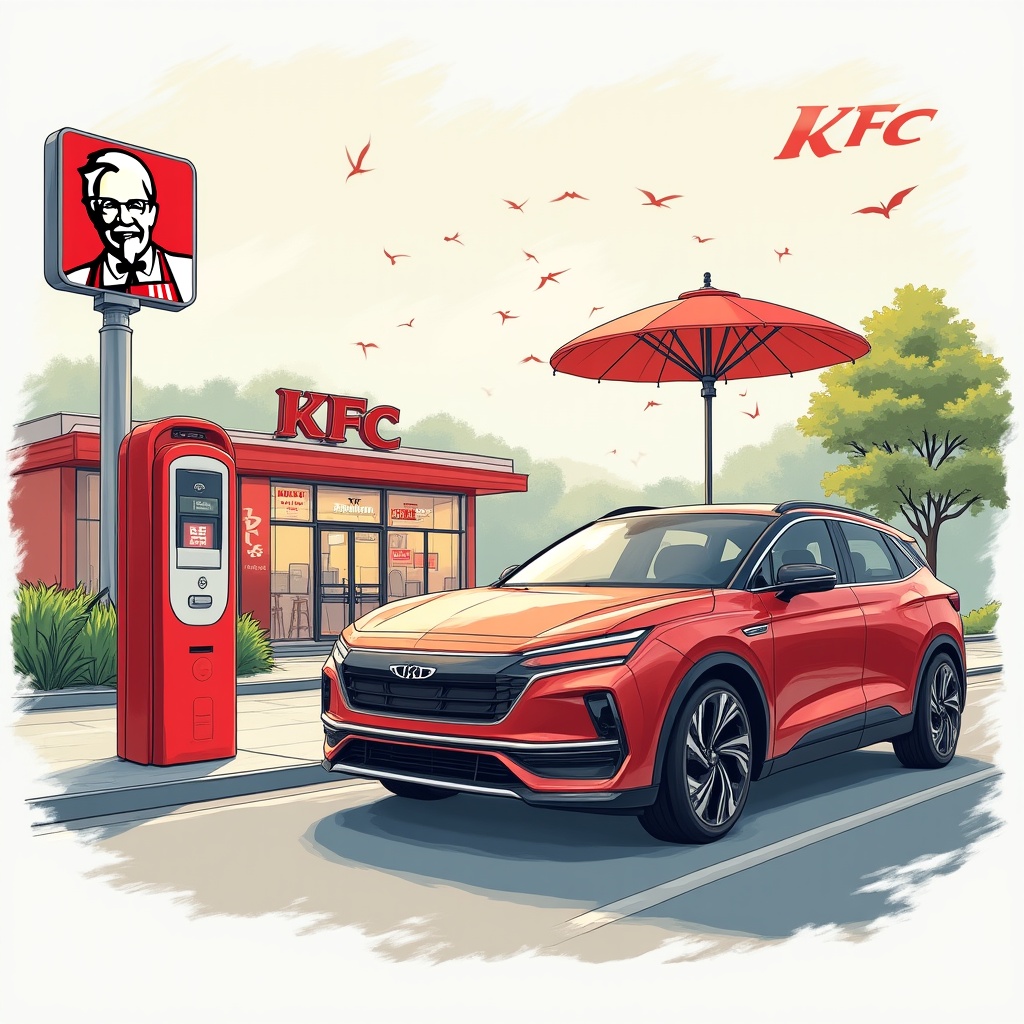
BYD teams with KFC China on ‘nine‑minute’ EV top‑ups, signaling new retail-energy tie‑up in world’s largest auto market
BYD and KFC China plan a nationwide rollout of sites offering a “nine‑minute” vehicle top‑up alongside drive‑thru service, underscoring how retail traffic and fast charging are converging in China’s electric car boom.
China’s BYD has announced a collaboration with KFC China to pilot and scale drive‑thru locations that promise a roughly nine‑minute vehicle top‑up alongside food pickup, a move that fuses quick‑service retail with rapid EV charging in the world’s largest auto market. The initiative, disclosed on April 9, 2026, highlights how automakers and consumer brands are experimenting with convenience‑led infrastructure to meet rising electric demand and capture new customer touchpoints across mainland China’s markets.
The partners aim to build out a network where drivers can combine meal orders with a short charging stop, targeting a sub‑10‑minute turnaround that narrows the convenience gap with conventional refueling. For investors tracking mobility, retail, and infrastructure, the tie‑up offers an early look at how ancillary revenue and footfall could be reshaped by integrated energy services at high‑traffic sites.
Key details
- BYD announced the collaboration with KFC China on April 9, 2026, positioning the rollout for mainland China.
- The concept centers on a “nine‑minute” top‑up window, seeking to align charging dwell time with a typical drive‑thru order and pickup.
- China’s electric vehicle penetration surpassed 30% of new car sales in 2023, creating a broad addressable base for destination and on‑the‑go charging.
- China hosts over 2 million public charging points nationwide as of recent industry counts, but availability and speed remain uneven by city and corridor—leaving room for high‑utilization sites at major retail nodes.
What changed vs prior baseline
- Retail-energy convergence: Fast charging moves deeper into mainstream consumer venues, shifting from standalone stations toward high‑traffic restaurants and drive‑thrus.
- Time‑bound charging target: The nine‑minute benchmark tightens the service promise relative to many fast‑charge sessions that commonly take 15 minutes or longer, reframing charging as an adjunct to routine purchases.
- Automaker‑led deployment: BYD’s direct role elevates OEM participation in siting and customer experience, beyond hardware supply, to capture data, loyalty, and ancillary spend.
- Networked co-branding: Pairing automotive energy services with a national quick‑service chain increases potential scale and marketing reach versus site‑by‑site charging partnerships.
Why it matters
Charging convenience is a critical hurdle for mass EV adoption and a determinant of utilization economics for infrastructure owners. Embedding rapid top‑ups in familiar drive‑thru formats could reduce perceived friction for first‑time EV buyers, boost average ticket sizes for retailers, and create new revenue streams tied to dwell time and energy sales. For markets and stocks exposed to China’s auto and consumer cycles, the collaboration points to adjacent growth pools beyond vehicle sales alone.
Market implications
Equity investors
- Automakers: A successful format could deepen post‑sale monetization via charging, data, and subscriptions, potentially supporting higher lifetime value per vehicle.
- Quick‑service restaurants: Co‑located charging may lift traffic and average checks during non‑peak meal periods, though benefits hinge on throughput and energy pricing.
- Charging operators: Competitive dynamics may intensify if OEM‑retail alliances secure prime sites, pressuring standalone networks to differentiate on speed, price, or coverage.
Credit and infrastructure investors
- Project finance: Drive‑thru‑based charging can improve utilization visibility due to stable footfall, supporting underwriting assumptions on cash flows and shortening payback periods.
- Real assets and REITs: Landlords with high‑traffic pads could command better lease terms by enabling multi‑revenue sites (food service plus energy), but grid upgrades and demand charges remain key variables.
ETF and sector allocation
- Thematic ETFs focused on EVs, batteries, or smart mobility gain another proof point for ecosystem revenues beyond car sales, potentially broadening factor exposures to consumer discretionary.
- China consumer and autos allocations may see sentiment benefits from cross‑sector collaboration, though execution risk and macro drivers (rates, inflation, domestic demand) still dominate performance.
Operational considerations
- Power availability: Delivering consistent sub‑10‑minute top‑ups implies high‑capacity DC infrastructure and grid connections sized for peak mealtime loads.
- Site design: Traffic flow must prevent queue spillovers, with layout optimized so charging duration aligns with order preparation and pickup.
- Pricing and loyalty: Bundled offers (energy plus meal) and app integration can steer utilization and hedge energy cost volatility.
Risks and alternative scenario
- Grid constraints and demand charges: Limited local capacity or high peak tariffs could erode unit economics, extending payback periods.
- Technology variance: Real‑world charging times depend on vehicle chemistry, state of charge, and ambient conditions; not all models will achieve a nine‑minute experience.
- Utilization risk: If customer flows cluster at meal peaks, stations may face congestion at certain hours and low use at others, weakening average returns.
- Regulatory and permitting: Local rules on electrical upgrades, signage, or curb management could slow deployment timelines.
- Competitive response: Rival OEMs, oil majors, or independent networks might accelerate partnerships with other chains, fragmenting standards and loyalty ecosystems.
What to watch next
- Pilot performance: Throughput per charger, average dwell time, and attachment rates for bundled food‑and‑charge offers.
- Geographic rollout: Expansion beyond tier‑1 cities to suburban and highway locations where charging gaps remain pronounced.
- Pricing model: Dynamic pricing tied to off‑peak hours to balance load and protect margins.
- Capital intensity: Per‑site capex and the mix of on‑balance‑sheet funding vs. third‑party finance or joint ventures.
FAQ
What does “nine‑minute” refueling mean in this context?
It refers to a targeted fast‑charging or rapid top‑up window designed to fit within the time it typically takes to place and collect a drive‑thru order, aiming to make charging feel as routine as a food pickup.
Where will the collaboration roll out?
The partners cited mainland China as the focus, leveraging high‑traffic quick‑service locations for co‑located charging and drive‑thru operations.
How does this compare with conventional fast charging?
Many fast‑charge sessions today take 15 minutes or more depending on vehicle and charger. A sub‑10‑minute target, where achievable, would reduce dwell times and improve site throughput.
Who operates KFC in China?
KFC China is operated by the local franchisee organization, which runs the brand’s restaurants across the mainland market.
What is the investment angle?
Potential beneficiaries include automakers pursuing post‑sale energy revenues, quick‑service chains adding traffic via charging amenities, and infrastructure investors backing high‑utilization urban sites. Execution, grid capacity, and pricing discipline will determine financial outcomes.
Sources & Verification
-
View sourceCNBC Top Newswww.cnbc.com


